Friday, October 19, 2012

Zermatt - September 5, 2012

 A four-hour train ride will take me from Milan to Zermatt, with a transfer in Brig, Switzerland.  Just as no one asked to see my passport when I arrived in Rome from New York, after changing planes in Berlin, no one asks to see my passport as the train moves from Italy to Switzerland.


On the way down the mountain
At the border, a cute little dog boards the train happily wagging its tail. I do not notice at first, and then I realize a Swiss guard accompanies it, their only concern is drugs. The dog obviously enjoys its work, I watch as it gives my luggage a careful sniff and then wanders off to investigate the next suitcase.

The transfer to another train in Brig is easy, yet a little complicated, here the language is German and I cannot find my train. A helpful man accompanies me to where I catch the train, which is outside and in front of the train station, more like a bus stop. The train to Zermatt runs about every half hour. 

It is during this portion of the trip that I receive my first taste of Switzerland's landscape.  Swiss chalets rest on steep mountain slopes, and I wonder how the owners keep their grass cut. I will eventually "get it", chalets are built on Alpine pastures, and there is no need to cut grass. Waterfalls cascade, rivers flow pure and the jagged edges of mountaintops patched with snow point into an azure sky.

A short and pleasant train ride brings us to Zermatt, the end of the line. It is at the foot of the mighty Matterhorn. My first stop, as is always the case, is the tourist office where I expect to receive a map and directions to my hotel. I'm staying at Hotel Darioli, a short walk up the street from the train station.

After I survey my room and get rid of my suitcase, I get my bearings by walking around town.


Zermatt to Gornergrat - September 6, 2012

A beer really hit the spot and the view
Fantastic
The first thing I do this morning is purchase a backpack; after that I venture into the grocery store and buy a sandwich, granola bars, fruit and bottle water. Bottled water is hard to find because there is no need for it. Fountains with drinkable water flow in many parts of Zermatt, and the tap water is delicious. It is the bottle I need I pack my bag, I return to my room, put on my hiking boots, pack my backpack, and I'm ready to hike the Alps. I'm off to a place called Gornergrat.

Advertised as "the highest altitude cogwheel train in Europe, to run completely in the open air," I'm not certain what this means, but it sounds impressive. It is expensive, 40 Swiss Francs one way, with assurance from the ticket agent that I can purchase a ticket to come back if I change my mind, my ticket will take me to the top and it will take four hours to walk down.


Other train passengers assure me that the walk down is easy, besides there are many people on the paths, they say, and encourage me to give it a go.  It is a steep down hill trek and in the beginning the path is full, but as time lapses the number of people walking diminished. Experienced Alpine trekkers and a determined me continue to the bottom.

After two hours on the path, my knees occasionally buckle. Sometimes I walk so slow I'm almost at a standstill, but I simply cannot move any faster. After spending four hours walking down what is mostly a steep slope with my toes pushing against the end of my hiking boots, my toes are bruised purple.

Along the trail I encounter a posh resort with what is likely the most beautiful view of the Matterhorn available. I stop to drink a beer, rest my legs for a while and hope that I will make it down to the bottom of the mountain.

At last, I meet up with the mountain biking trail, which proves to be an easier walk. A German couple meet me along the way. They decide to continue on the hiking trail.

"We are crazy,” the woman announces.

"You are crazy?" I ask.

 "Yes, we are crazy."

"I am tired," is my parting remark, as they continue on the hiking trail, and I choose the less challenging mountain bike road.

At first I'm certain I will lose the nail on my big toe, and may, eventually. My toes will be bruised purple for a long while to come.

Gornerschlucht - September 7, 2012

Gornerschlucht
Knowing little about Zermatt, I mistakenly think I can catch a bus to Gorner Gorge. No, I'm told, the way to get there is to walk. "I'm not sure I can," I say. Although I'm told that it's not far and it’s an easy walk, I remember that was what I was told about Goernergrat.

I'm no sissy. I wear my sneakers instead of hiking boots, easier on the toes, I hope. Off f I go to find the gorge. The gorge is not for those who fear heights, the Gornervispe River took thousands of years to twist 220 million year old rock into weird shapes, and continues its work today, as water energetically swirls at the bottom. For the more adventurous, it is possible to cross the gorge with special equipment. For the more sedate, between 1886 and 1887 a bridge was built, fastened to the cliff and overlooking the gorge.

The Only Way to Hike - September 8, 2012

Alpine scenery
Today I devise a hiking style. The trails are clearly marked and each sign indicates the time it will take to walk to the next hamlet, twenty minutes, forty-five minutes, and hour, never very far. Most hamlets have a restaurant. Walk a little, eat a little, take a few photos, and admire the scenery, a fantastic way to spend a day.
 

Monday, October 01, 2012

Milan - September 4 - 5, 2012


I arrive in Milan. As I pull my luggage behind me, walking away from the platform and toward the station proper, the immensity and beauty of the station beguiles.

Milan feels different than many other parts of Italy. Modern, business-like and brimming with sophistication, my hotel, Mennini, is a different matter, rough around the edges and in need of a renovation.

Center of Milan
Streetcars deliver passengers around the city. The main square full of fashionable shops with names such as Dior and Versace let visitors know they have arrived in one of the world's fashion capitals.

The Museo del Novecento displays works of the twentieth century. The exhibits, set in chronological order, begin with Italian art produced circa 1900 and ends with works from 1968. Spiralling stairs lead the way into assorted rooms, each one themed with a different era and different style.  Impressionistic, abstract and realistic works are explained in historic context and consideration given to influences of the time, and the artistic talents and personalities that went into creating the pieces.


Venice - September 1 - 3, 2012

San Marco - Venice main piazza

Its 26 million or so visitors each year give testament to the uniqueness and beauty of Venice. And yet, I cannot help but question its very existence. Resting on sand bars that reach into the Mediterranean Sea, its biblical paradigm comes to mind.

Somewhere in the New Testament, Jesus tells the parable of building a house on sand, as opposed to rock. In Venice, I see many a large and imposing edifice, somehow still standing, after several hundred years, even though its foundation is weak.

Forced into the sea by invaders, Venetians made the sand bars their home. Through the salt the sea produces, they became exceedingly wealthy and collected the trappings that money provides. Culture, art and beauty are everywhere.

Bologna - August 31, 2012

Bologna library

Alessandra's friend Elena sees me off; I'm on my way to Bologna. She tells me it is a university town. After checking into the hotel I Portici I make my way to the center of the city. 

My short stay means I see little of Bologna. Since it is a city for students, what better place to visit than one of the many libraries? I visit Biblioteca Comunale dell'Archiginnasio. Constructed between 1562 and 1563, the library's long history speaks of the many scholars, past and present, who have made good use of its learned halls. Today the Società Medica Chirurgica and by the Accademia di Agricoltura occupy much of the first floor, portraits of distinguished doctors fill the walls. 

Living La Dolce Vita


The Tortelli's

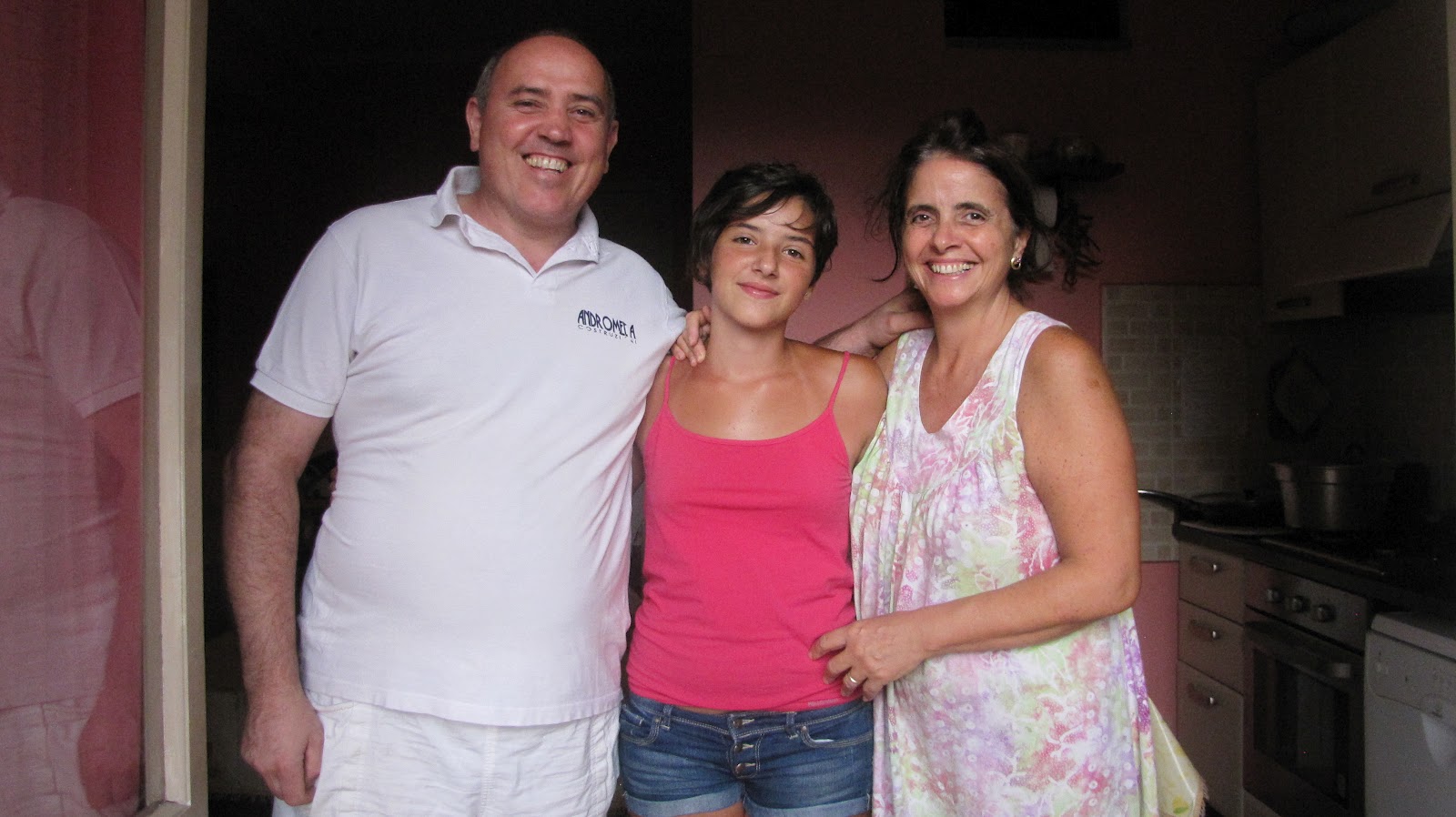
I met the Tortelli family last September. If you would like to read about how we met I've written a short story about it.

The Tortelli's are my way into Italy's famous "dolce vita".  They are a not so rich family that benefit from the social democratic government that places a sliding scale of the cost of activities children might enjoy. The two youngest Tortelli girls took two-week trips around the Mediterranean Sea, one on a catamaran the other on a sailing ship.

The oldest girl will study abroad next year. The middle daughter will attend a music academy and the youngest needs to be reminded to do her homework. All three girls are extraordinarily beautiful.

The mother, Gloria Tortelli, simply must have cheese, onions and garlic in her kitchen. Gloria's husband, Giuseppe, cannot do with his bread and wine. At their kitchen table, everyone talks at once.

Picnic on the Wall - August 30, 2012

Last September, when I studied Italian in Lucca, I stayed with Alessandra. We planned to hike in the mountains today. However, she called yesterday to let me know she had to work, but invited me to picnic this evening.

Italians eat their last meal of the day sometime after 8 pm. It is dark when we gather in one of the many parks on Lucca's wall. I remember some of the people gathered from my last visit. A congenial group, on the picnic table they display an abundance or food and wine.

At one point I wander off a bit, full of food and drink, feeling the cool evening breeze and marveling at the beauty that surrounds me, I conclude, Italians truly live the good life.

Palazzo Pfanner - Lucca, Italy


Commissioned in 1660 by the Moriconi family. In 1680, ruined by bankruptcy, they sold the building to the Controni family, who presided over the completion of the palace. Adding to the plans, building the grand staircase, upgrading the gardens and arranged for the trompe l'oeil, which can be seen throughout the house.

In the middle of the 19th Century Bavarian Felix Pfanner purchased the palazzo. It became a brewer, and its gardens a beer garden, and remained so until 1929.

The palazzo is still owned by the Pfanner family. In 1995 the family began the work of restoring the property to its original grandness with the idea of opening it up to the public.


Viareggio, Italy - August 27, 2012

Viareggio, Italy

To arrive at the resort town of Viareggio from Lucca, it takes a picturesque bus ride that costs 3 Euro one-way. Although not surprised, I'm not use to what I see on the beach. Sign after sign, each with the name of a particular bagno, advertises that for an amount of money, I do not inquire as to how much, people can access the beach, along with a change room, lounge chair and umbrella. Where I come from, free beaches complete with a bathroom and change room, belong to everyone.

In the design of its buildings, Viareggio looks something like Miami, Florida. Perhaps I should say Miami looks like Viareggio. Located in Versilia, which is the Italian Riviera, with green hills and jagged rocky mountains in the background, blue sky and waves from the Mediterranean Sea lapping the shore it is a place that you savor.

People lying in the sun turn themselves almost crisp black, while men, whose color borders on ivory black, sell hats that can provide protection from the sun.  Men, no women, fish in the waters, and very young girls go topless while their mothers keep themselves modestly covered.

There are boats in the harbor. Sailboats, yachts and cruisers all designed to provide pleasure whenever their fortunate owners lift anchor.

Florence, Italy - August 21, 2012

Replica of Michelangelo's David
located where the original once stood.

David

During a school assembly when I was in elementary school, we watched a film about Michelangelo's David. I'd like to believe, in spite of evidence to the contrary, each of us makes decisions, puts together hopes dreams and ambitions, and either consciously or unconsciously fulfills the destinies we carve. By the end of the film, I knew one day I would see that statue up close and personal.

Its position in the Galleria Degli Accedemia is grand. He stands tall at the end of a hall that displays many of Michelangelo's unfinished marble pieces.

However, I may be the only person on earth who begs to differ with those who believe David is perfectly proportioned. I have trouble with his hands and feet because they appear too big for the rest of him.

Most David's are victors, depicted after they have slain Goliath. However, this David readies for battle.  His first home was in front of the Firenze City Hall, where a copy stands today. The city, like David, stands ready to do battle with the larger and more powerful cities of the area. Although, for the life of me, I cannot imagine a Tuscan city more powerful than Florence was during the Renaissance.

A portion of Bascillica de Santa Maria -
Bascillica di Santa Maria del Fiore ( Saint Mary of the Flowers)

Construction of the main cathedral in Florence, which is a UNESCO World Heritage site,  began in 1296. It took 140 years to complete. Architects planned that it should include the world's largest dome. The problem was, no one knew how the build such a dome. The incomplete cathedral remained an embarrassment to Florentinians until Cosimo de' Medici commissioned the work to be complete. The contract was awarded to Brunelleschi, who in designing and undertaking the supervision of building the dome, accomplished what was thought to be impossible. It remains, to this day, the largest brick dome in the world. 

Ponte Vecchio

Ponte Vecchio - oldest Florence, Italy
bridge
Although flooding almost destroyed the bridge in 1333, it has stretched across the Arno River since Roman times. During the 15th Century fishmongers, butchers and grocers sold their smelly items in shops lining the bridge, but were replaced by goldsmiths. The oldest bridge in Florence, today the shops on the bridge sell jewelry and souvenirs.


Castello Malaspina - Massa Italy


Today, August 16, 2012, I travel to Massa to visit a castle. Because of the narrow one-way streets with inadequate signage, the city is difficult to traverse. I ask and receive help from two very cute nuns dressed in gray habits. They suggest I follow them. And there we are, two nuns in front and me in back comprising a very short two car parade.

We arrive at a parking lot, they point; I park. Just before driving off they wave toward the top of a high hill, there rests the castle. From here I walk, snapping a photo or two before my camera lets me know I need to change batteries. Since buying batteries might be a challenge, I use my new smart phone. Many stairs and a cobble stone road lead the way.

The castle-fortress is immense. Records of a structure existing on this spot date back as far as 1164. However, in 1269 soldiers from Lucca leveled the structure that once existed. Sorry, I don't know when the castle that currently exists was built. However, I do know it change hands several times throughout the centuries and its last non-tourist use, as a prison, ended in 1946.

On a scale from one to ten, I rate a visit to this castle at eleven. If you are plan to visit northern Tuscany, this castle is a must see, the immensity of it so mystifying that finding my way out challenges my navigational abilities.

Unfortunately, I somehow delete all the photos taken on my smart phone. 

Friday, September 28, 2012

Grotto Del Vento and Pont Diavolo


For me, my drive north of Lucca ended at Grotto Del Vento, although it is possible to drive farther into the area of  Alpi Apuane National Park, the drive up to here is sufficiently wild.

Grotto Del Vento

Guided tour in Italian, English is available
when there are enough English speakers
I listened to an audio while touring
No need to register for a regular tour, designed to educate rather than thrill.  Electric lighting, handrails and steps provide adequate safety. Visitors choose between three tours, taking one hour, two hours and three hours respectively. I purchase the three-hour visit. The first part of the tour took place in the part of the cave where stalactites and stalagmites still grow. An underground creek runs through the second area. In the third, we find a perfectly vertical 90-meter shaft and the bed of the cave, consisting of fine sand.

Ponte Diavolo (The Devil's Bridge)

Worth the see - quite a site
On the way back to Lucca, I stop in the town of Borga Mozzano to see Ponte Della Maddelen, commonly called Ponte Diavolo. Quoting from a brochure "A great example of medieval engineering with five asymmetrical arches that are reflected in the water of the Serchio River. The biggest is 40 metres wide and 18.5 meters high. Built in the 12th Century, it is one of the most well-known monuments of the province of Lucca."

Touring North of Lucca, Italy


Camper in background and tanker truck
 in foreground managed somehow
 to pass one another

In southern Mexico, Guatemala and Belize, tour operators earn a living driving tourists to various attractions that are off the beaten path. In Canada, my home country, when a visitor explores outlying areas they must rent a car. The same thing seems to apply in Italy.

The steep and winding roads that take adventurous tourists and locals into the mountains and through ancient towns were built long before the automobile was invented, and demand caution. Perhaps because of the caution demanded, locals muster infinite patience, at least some of the time.

Ahead of me, a tanker trunk comes down the hill, while a camper goes up. How can they pass each other? They form a blockade. Vehicles pile up behind the blockade. I back up a short distances and move my car onto a piece of grass, which fortunately allows me to move off the road and not down the mountain.  I put the car in first gear, put the emergency brake on, get out of the car, lean on the hood, and watch the show-taking place in front of me.

The truck and camper try to maneuver around each other. As the line of vehicles grows, so does the impatience of drivers and passengers. They shout and wave fists. I think someone suggests a call to the police.

In some fashion, and I honestly don't know how, the truck and camper manage to find a way to pass each other. The rest of the vehicles move on. When all is quiet, I move from my spot, start my car, and go on my way. Fascinating! Grotto del Vento awaits.

Tuesday, September 25, 2012

Late Luggage and Recovery: The Italian Way


Tuesday, September 31 and Wednesday, August 1

I fly AirBerlin from the JFK airport, headed to Lucca, Italy by way of Berlin, Rome and Pisa. The flight is delayed on the JFK runway. Although I make the Berlin transfer, it does not surprise me that when I reach Rome, my luggage is not on the plane.

The next flight from Berlin to Rome is scheduled to arrive at 6:30 p.m. My first thought is to remain in Rome until my luggage arrives, which means I miss my flight to Pisa. I know if I continue my journey to Lucca without it, a struggle is sure to ensue. Italy has its own rhythm. However, what if my luggage is not on the 6:30 flight? I've wasted time and money.

I fly to Pisa and take the bus to Lucca. By 6 p.m. I settle into my apartment.  I use Skype to call Rome's lost baggage department.  I must give them my address. I discover that the baggage office closed at 5:30 p.m.

Thursday, August 2

 Luggage - Retrieved at last
I begin calling at 8:30; the office should be open.  At first, no one  answers, then I receive repeated busy signals, sometimes the phone is answered, and then disconnects. I persist. Eventually, speaking to someone. Bad news, without a telephone number my luggage won't be delivered.

 The apartment I rented does not include a telephone. Although I brought my cell phone, and planned to purchase a SIM card, I forgot the charger. I decide to treat myself to a new cell phone. After all, do I have a choice? Buying one will prove a challenge.

I begin at the tourist information office and learn a company called TIM sells and maintains Italian cell phones. At the sales office, no on speaks English, and I struggle to explain and understand. By early afternoon, I own a new cell phone.

Attempting to contact the Rome baggage office to give them the required number, again I experience repeated busy signals, and I worry the office will close before I reach anyone. I luck out, and manage to give someone my number. My luggage will be delivered on Monday, or so I'm told. So much for the four day maximum quoted delivery. I shop; I spend money and wait.

Monday, August 6

I decide to confirm delivery, and again, beginning calling at 8:30 in the morning.  Finally reaching some one, I discover my suitcase remains in the Rome storage area, no explanation given. I tell the woman I'm speaking to that  I will pick-up my bag in Pisa. She promises my luggage will arrive in Pisa on the 2:45 p.m. flight.

I take the bus to Pisa, which takes a little over a half hour. My luggage is not on the flight. Staff in the Pisa baggage refuse to call Rome. They email and wait. Apparently they only have the telephone number I have and aren't prepared to experience hang-ups, busy signals and no answers. I doubt the Rome office will read the email anytime soon.

I remember I have a cell phone, and begin using it. Eventually reaching a person. My luggage left the storage area. She doesn't know why it wasn't on the flight. Apparently it isn't possible to telephone the area of the airport where my suitcase may be sitting. She must email and will call me when she receives an answer. I don't bother asking when she will receive an answer because she won't know and it could be days, or not at all.

If I stay in Pisa until the next flight from Rome, I miss the last bus back to Lucca. I leave Pisa. Sometime after 10 pm, I receive a call; my luggage now resides in Pisa.

Tuesday, August 7

Feeling confident, I ride the bus to Pisa. Upon arrival, I speak to the same woman I spoke to yesterday. She makes it absolutely clear that the telephone call I received was not made by anyone working in lost baggage, and leaves to investigate. Perhaps my luggage is not in Pisa after all.

Several stressful minutes pass, and then my suitcase is placed in a sort of revolving trap door.  The lost baggage area is well protected. I think some passengers just might threaten bodily harm. A group from Belgium is returning home today, and is told their missing luggage might arrive tomorrow.

AirBerlin

Receiving compensation is impossible. No one answers phones; emails are answered requesting more and more information. I give up.

Saturday, August 18, 2012

On the Road - In the Air and Across Europe - July 31, 2012


After breakfast I pack up, which doesn't take long. Since my plane is not leaving until 5:30 this afternoon I have plenty of time.

How do I get to Penn Station? Do I travel by subway, taxi or bus? Apparently the bus driver won't let me on the bus with my suitcase. I wonder how I can make it through the subway turn style with my suitcase. Jane tells me the conductor will open the emergency gate so that I can get through. "Is there a conductor at the 125th and Lenox stop?" I ask. Jane says she doesn't know.

I make a trip to the subway stop and find out there isn't a conductor. I decide to take a cab. On the Internet I find a company called Groundlink, which suits my needs to a T. I know exactly what it will cost before I get into the car. They don't allow driver's to take cash; all transactions are taken via a credit card, over the phone.

My driver picks me up on time, but further complicates things by telling me that there is a train very close to where I'm staying that will take me to Jamaica Station, on the other hand for (I don't remember the extra money) he can take me to Jamaica Station or to the airport for that matter.

Until now, I've been geared to the idea of going to Penn Station and taking the train from there to Jamaica Station.  Then taking the Jamaica Station train to my terminal.

I tell him I want to proceed as I originally planned. Still, he insists on being helpful and gives me all kinds of unsolicited information.

I tell him that although I'm grateful for his desire to be of assistance, I won't remember what he is saying because my short term memory isn't as good as it once was. This is true.

I don't tell him I'm positive I will get to where I'm going in plenty of time without his advice. And that is also true.

My flight will take me to Berlin where I transfer to another flight, which will take me to Rome. It will take around 24 hours to arrive at my final destination, Lucca, Italy.

Revisit Rockefeller Center - July 30, 2012


My friend Mimi gave me a package to deliver to her ex-husband, who lives in Switzerland. On the other hand, it was obvious from her conversation that she preferred that I mail it from New York.

Last week I purchased New York t-shirts for my granddaughters and a New York Fire Department cap for my grandson. I want to mail them. So, on my agenda today is finding a nearby post office and sending parcels.

However, I can't find the bag with the t-shirts and cap. I haven't a clue where I left them. And so it is, I must find somewhere to again purchase the lost merchandise. Since it would be impossible to remember the store I bought them from, I decide my best bet, considering my limited knowledge of the city, is to return to Rockefeller Center.

I hop on the bus, come back with my purchases, and find my way to the post office. I'm surprised at how little it costs to send these packages first class. 

The Highline, Central Park Concert, A Fight and A Fire - July 29

I'm winding down my visit to New York.  I've had only a small sampling of the big apple has to offer, but I'm a traveler who likes to take it easy rather than rush around. I want to savor the sites and sounds.

From my reading, it seems that railroads were quite the challenge and threat in Manhattan's early days, which is part of the reason why the subways were built. In 1930, Manhattan decided to move the railroad tracks 30 feet above the streets. Do you remember any of the old 1930's movies where people lived along side the tracks that were above ground?

Highline trail/park
Trains have not used the tracks since the 1980's. During the 1990's it appeared to some that the sensible thing to do was to tear down the unsightly tracks. Other people had a different idea and formed the Friends of the Highline.

What was once a 30 feet above ground railway system, is now a foot passenger park and garden.  I stroll the Highline, have lunch in the area and make my way to Central Park.

Each Sunday in Central Park there is a free concert. This week the concert celebrates the Latinos of New York. I discover most are from Puerto Rico and the Dominican Republic.

There is plenty of security, the NYPD, private security and guardian angels with their jaunty red caps. I'm about to photograph two guardian angels when they suddenly run in the direction of the entry gate, as do many other people.

I decide to stay put knowing someone will report the goings on and I will be able to overhear what was happening. The interpretation of an individual can be more entertaining anyway.

Soon, a woman returns to report to her friends. Two white guys had too much to drink, a Latino bartender refused to sell them any more alcohol. They became angry and attacked the Latino. Suddenly this is a race issue. The Latinos around me express their indignity in both Spanish and English.

Fabulous view from Central Park
The concert seems to take forever to begin. I'm tired of waiting and decide to continue my long journey through the park and eventually to Jane Darling's.

I take the bus part of the way; the bus that can deliver me to 125th Street does not run on weekends. And so it is that I will walk from 110th Street to 125th. When I get off the bus I notice, perhaps thirty, maybe forty, fire and rescue trucks. I notice on the side of some of the trucks is written "high rise rescues" I had not thought about it until this moment, but a high-rise fire is very complicated.

I don't continue my walk north on Madison to 125th, but instead walk one block west to 5th Avenue to avoid whatever is going on.

I ask Jane about this, and she tells me that with all the heat and no rain, that is until I arrived in the city, there has been more than the usual number of high-rise fires.


Museum of Modern Art, Gore Vidal's The Best Man and Stranger-Friends - July 28

Although it has been hot throughout my stay in New York, it as also been raining. I carry my umbrella everywhere I go. Today I decide to visit the Museum of Modern Art and attend another Broadway play.

The Museum of Modern Art (MoMa),unlike the Metropolitan Museum, has an absolute admission price of $25.

When it comes to art I'm not very knowledgeable. When I was in grade eight there weren't enough desks in the art room for all of us, they were two short. Rather than finding other desks, which would have been the proper solution, administration invited students to apply to not attend art class. I won the prize. I could spend the time fellow classmates were in art class in the library, using the time as a study period. Thus ended any study of art I might have had.

MoMa's most intriguing piece
As little as I know about art, I can recognize Monet, Picasso, Andy Warhol, Georgia O'Keefe, Francisco Goitia and Frida Khalo. And I know Washington Crossing the Delaware when I see it, although I have no idea the one in the gallery is a fake until I read the information. Oh, by the way, I do see artwork by Monte, Picasso and Andy Warhol, but not Georgia O'Keefe, Francisco Goita or Frida Khalo.

The most intriguing piece of art appears to be by Lee Bontecou, who created it in 1961. It is made, in part, from a discarded laundry conveyor belt that she found below her East Village apartment.

I watch as others, like me, walk up to the piece and allow themselves to be lured into what feels like a never ending well leading to nowhere.

After visiting MoMa I find my way back to my least favorite place, Times Square. I plan to attend another Broadway Play.

The line-up at TKTS is very long, and while we stand in line the rain begins to come down in buckets. Fortunately there is no wind and my umbrella provides protection.

Two men are standing behind me. I offer the services of half my umbrella. The shorter man takes me up on my offer. The taller man stands in the rain. After a short time he is wet to the bone and wonders why he is standing in the rain because he can go somewhere that is dry and let his partner buy the tickets. The Olive Garden is across the street and we all have the same plan. After ticket purchases that's where we are going.

Someone assumes my umbrella partner and I are together. That is when I came up with a new word, stranger-friend. I have met many stranger-friends in my lifetime. People who are significant for a blip in time and then I never see them again. It is my turn to purchase a ticket. My stranger-friend and I part company, lucky for him there is now room under the overhang. He keeps dry.

I buy a ticket to Gore Vidal’s The Best Man. The main reason for my choice of this play is because Elizabeth Ashley is one of the stars. She has always interested me, and she has always thought of herself as a Broadway actress first and foremost.

After my purchase, I make my way to the very crowded Olive Garden and may need to wait for a very long time for a table. Then I meet another stranger-friend. We decide we will sit together if it means getting a table sooner. Wow! We really luck out.

A party of two obviously tired of waiting and left their pager. The maître d' tells us if we will be a party of two we can have the pager. Likely we will have a table in about ten minutes.

At first my dinner partner spends her time texting her friend and when our dinner comes, she's ordered a wide variety of meals planning to take food home, she is busy photographing food and sending the photographs to her friend. I assume her friend didn't have the money to accompany my stranger-friend to Fella, the afternoon performance she has just finished attending.

I, without a cell phone, am interested in observing her. When she is ready she warms up to me and begins to talk.  I learn she is originally from Haiti, lives in Brooklyn, works as an assistant manager at Payless and has another part-time job.

When we are ready to leave and part company, she asks me to take a photograph of her. I do, and suggest, in fact I slightly urge that she also take a photograph of her stranger-friend. She takes a photo of the two of us. Now, she is ready to be totally open and tells me she has never heard the word stranger-friend before. "That's because I invented it," I tell her.

She says she has very much enjoyed talking to me. Actually, one of the rules of being a stranger-friend is to always be sensitive to the other person, give them their space and speak only when it appears to be the right thing to do. I don't tell her any of this. However, I know she is sincere. In the end my congenial company was better than eating alone, or texting.

She's on her way home and I'm on my way to the play.

At the play I sit beside a man who decides to be a stranger-friend. We discuss why we have chosen this play and remark on the large number of well-known actors in the cast. There is James Earl Jones, a veteran of Broadway, Elizabeth Ashley, Night Court's John Larroquette, and well-known film and television star Cybil Shepard in her first Broadway appearance. Unfortunately a stellar cast does not necessarily equate to stellar performances. The play lacks depth and falls flat.

It is the end of another busy day in my visit to New York City. It is back to Jane Darling's Bed and Breakfast.

Monday, August 13, 2012

Angelika Film Center - Searching for Sugar Man, The Queen of Versailles, To Rome with Love - July 27


Over the last few days, a family from France has been staying at Jane Darling's Bed and Breakfast. New York is very hot, especially on the third floor where my room is located. I can take the heat during the day, but 100 or so degrees Fahrenheit makes sleeping impossible.  Jane has air conditioning, so sleeping shouldn't be a problem. But, the French woman kept turning off the air conditioning.

My eyes have dark circles and I know I can't do anything too demanding today. I decide to find a great movie house. Angelika  is my kind of movie theatre. I spend several hours in the cooling comfort of the theatre and watch three movies.

I've been writing critiques at Rotten Tomatoes and here are my impressions of the movies

Searching for Sugar Man is an excellent movie. 

The Queen of Versailles is a must see for anyone who thinks it is possible to buy class. 

To Rome with Love clearly demonstrates Woody Allen's finest hours has long past. 

By the end of the day I'm totally refreshed, and Jane tells me she has had a talk with the French woman. I sleep well.

Tenement Museum and Blue Note - July 26


I have two couple friends, Margi and Gil and Joan and Doug, who are former New Yorkers.  Margi gave me a multitude of ideas of things to see and do in New York. Each morning I take a look at my file full of, among other things, ideas from Margi.

This morning I discover the information Margi gave me regarding the Tenement Museum; which is situated in the Lower East Side at 97 Orchard Street. From over 20 countries, between1863 to 1935 over 7,000 families lived, at one time or another, in this tenement. Generally the Lower Eastside was the next step after Ellis Island that would lead to a better life in America.

For the price of $22 I took one of the two "Hard Times" tours. The only way to visit the Tenement Museum is to take one or more of the tours offered.

Our first visit is the apartment of the Gumpertz family. They lived in the building in the latter part of the nineteenth century. Although it is not clear when the family moved in or precisely when they moved out one event is clear, one crisp day in October 1874 Mr. Gumpertz left the building and never returned.

Our guide asks us to guess what happened to him. Everyone guessed fowl play, everyone except me that is. I know what many men do when the going gets rough; they run. Eventually the mystery of Mr. Gumpertz is revealed. He ran and left Mrs. Gumpertz taking care of the children, alone.

The next and last, family on the tour is the Baldizzi family. The story on the website is different than the story our guide tells. Our guide reports that Adolfo Baldizzi, an expert cabinetmaker, came to America from Italy. He left is wife behind. When she had enough money she boarded a ship and arrived in America. But, on Ellis Island it was decreed she must return to Italy.

She saved enough for a second voyage across the ocean; this time she entered via Canada and crossed the border illegally, and spent the rest of her life as an illegal immigrant.

In 1937 the City of New York required extensive renovation to make 97 Orchard Street fit for habitation. Rather than make the renovations, the landlord shut the building down, with the exception of the two commercial spaces on the ground floor. The Baldizzi family had to leave.

The building lay dormant for over fifty years. The museum opened in 1992.

After leaving the Tenement, I walk through the Bowery. I've been here before, in the 1980's. It was much rougher in those days. The entire island of Manhattan appears to be under the process of gentrification. 

I eventually arrive where I want to be, Greenwich Village. I plan an evening of Jazz at the famous Blue Note.  However, it is still early. The Blue Note will not open for another hour or so. I sit in Washington Square and watch the goings on.  Something very interesting is happening. Shabby looking men are either playing chess or sitting at a chessboard waiting for a partner.

Apparently the guys sitting at the tables are Chess sharks, as opposed to Pool sharks. They sit and wait, hoping for a patsy. Interesting.

Eventually it's 6 p.m., which is when the doors to the Blue Note open.  There is a lower cover charge when one sits at the bar rather than a table. The woman who enters the club just before me is also alone. Actually, I have noticed how many people in New York go out alone, and how welcoming of company they are.

I pay the charge to sit at the bar. The other single woman, who has seated herself at what is likely the best spot in the house, offers to move over and share her spot with me. As it turns out, she is also visiting New York alone. Like me, her home is Vancouver, British Columbia.

 Conrad Herwig and his band play a set titled, The Latin Side of Joe Henderson. Prior to this collection Mr. Herwig has recorded The Latin Side of Miles Davis and The Latin Side of Charlie Parker, both of which were nominated for Grammys. Over the coming weekend he will record The Latin Side of Joe Henderson. He continually reminds the audience and invites us back for the recording session.

The cover charge allows for only one set. The set ends and my temporary companion and myself part company. It has been an enjoyable day.


Metropolitan Museum and a Broadway Show - July 25


Today the Metropolitan Museum is open. The recommended admission for an adult is $25, but visitors can pay whatever they like. I pay the recommended admission.

To visit the Met is an overwhelming experience and it's best to plan before going. I have not planned my visit. I take a quick survey and decide to begin with Egyptian art and continue in chronological order, although I can tell the museum isn't laid out that way. I begin with antiquity, Egypt and then Rome. Next, I move onto the medieval art. I get lost when I try to look for Renaissance art because it isn't in a particular wing or gallery.

I move onto the American wing, which has 73 galleries.

At the end of my visit, two displays will stand out most clearly in my mind. The Egyptian temple, which was a gift to the American people from the Egyptians and the rooms that trace the art of home furnishings from the beginning of United States history to the designs of Frank Lloyd Wright.

Explanation for Egyptian gift
The number of pieces people have contributed to the museum is immense. It reminds me of my visit to Wisconsin's House on the Rock, only these collections are far more sophisticated.

 The museum's website states its mission statement, which is:
The Metropolitan Museum of Art was founded on April 13, 1870, "to be located in the City of New York, for the purpose of establishing and maintaining in said city a Museum and library of art, of encouraging and developing the study of the fine arts, and the application of arts to manufacture and practical life, of advancing the general knowledge of kindred subjects, and, to that end, of furnishing popular instruction."1
In 2000 the board of trustees affirmed its original mission statement, and added this addendum.
The mission of The Metropolitan Museum of Art is to collect, preserve, study, exhibit, and stimulate appreciation for and advance knowledge of works of art that collectively represent the broadest spectrum of human achievement at the highest level of quality, all in the service of the public and in accordance with the highest professional standards.
Whether I spend one day, one week, a year, or the rest of my life, I could not begin to grasp the immensity of what the curators of the Met have done, are doing and will continue to do.

One last point, my friend Gil is a journeyman carpenter with a passion for wood. In the American wing there were so many beautiful wood pieces I think it would be his idea of heaven, since he, as I, do not believe in a heaven somewhere in the sky. I soon gave up trying to take photos to show him. The collection was too immense. He must go to the Met and see for himself.

I wasn't feeling well and my main concern throughout my visit was where the nearest bathroom was.

My intention is to see a Broadway play this evening. I debate whether or not to go to the theatre. I find a pharmacy, purchase some over the counter medications that the pharmacist recommends, hope for the best and stand in line at TKTS  to see if I can purchase a seat for the play titled "At the End of the Rainbow." The play is the story of the last few months of Judy Garland's life. TKTS offers last minute Broadway and Off-Broadway tickets at discount prices. My luck is good, and I have a feeling last minute tickets to Broadway performances are usually available. I purchase a ticket. The ticket seller seems to be quite delighted at the seat he is able to offer me.
 
The play is performed at the Belasco Theatre. The Belasco had its debut in 1907 and was designed to allow the audience an intimate experience of what was happening onstage. In 2010, it was restored to its original splendor.


The play is intimate and the theatre perfectly matches its venue. When the play is over, I think it was good but not any better than anything I have seen at the Manitoba Theatre Centre Let it be said that Winnipeg, Manitoba, Canada is a backwoods place with a surprisingly well developed arts culture.

However, over the next few days the depth of the play sinks into my psyche. Tracy Bennett gave an interpretation rather than an impression of Judy Garland. She sang many of the songs Ms. Garland was known for, gave an impeccable rendition of Ms. Garland's humor. Indeed, it was a haunting performance.

Good news, the medication worked and I was able to sit through the play without a desperate run to the bathroom.